What percent of cancel flows show a save offer, and which type?
- By Ali Abouelatta
- n = 48
- Published
- Updated
- 2 min read
- cancellation · retention · monetization · upsell · saas
Short answer
Among 48 apps with genuine cancel-intent screens, 30 (63%) surface discount or offer language on a cancel screen source[1]. Pause offers (0 of 48) and downgrade offers (0 of 48) are rarely observed in captured cancel screens — discount dominates by a wide margin source[2]source[3]. These are absence-in-vision-text signals, so treat the pause/downgrade zeros as 'rarely observed,' not 'never used.'
30 of 48 apps (63%) show discount/offer language on cancel screens; pause and downgrade near-zero, July 2026.
Bar chart · Share of 48
Share of 48 — The breakdown by offer type
One block is about 2.3%
- Discount / offer language
- 63% [1]
- Pause
- 0% [2]
- Downgrade / cheaper plan
- 0% [3]
The breakdown by offer type
Discount is overwhelmingly the observed save tactic. Pause and downgrade are near-absent in captured cancel screens source[2]source[3].
How to read the zeros
The pause (0/48) and downgrade (0/48) figures reflect absence in captured vision text, not proof the product never offers them source[2]source[3]. State them as 'rarely observed on cancel screens' rather than 'never used.' The 48-app denominator is the genuine-cancel-intent subset (screens whose text literally mentions 'cancel'), used because the raw category is polluted with paywall and win-back screenshots number[4].
How to apply it
If you are choosing one save offer to build first, a discount is what the field overwhelmingly ships — it is by far the most-observed tactic source[1]. Pause and downgrade are open space in this corpus source[2]source[3]: rarer, so potentially differentiating, but validate demand before investing. Note the field also runs discount-plus-loss-aversion win-back plays (e.g. Headway's 33%-off 'trial expired' modal) adjacent to the in-flow cancel screen number[5].
Real in-market screens
Screens from real, in-market apps, tracked by Lazyweb Research.
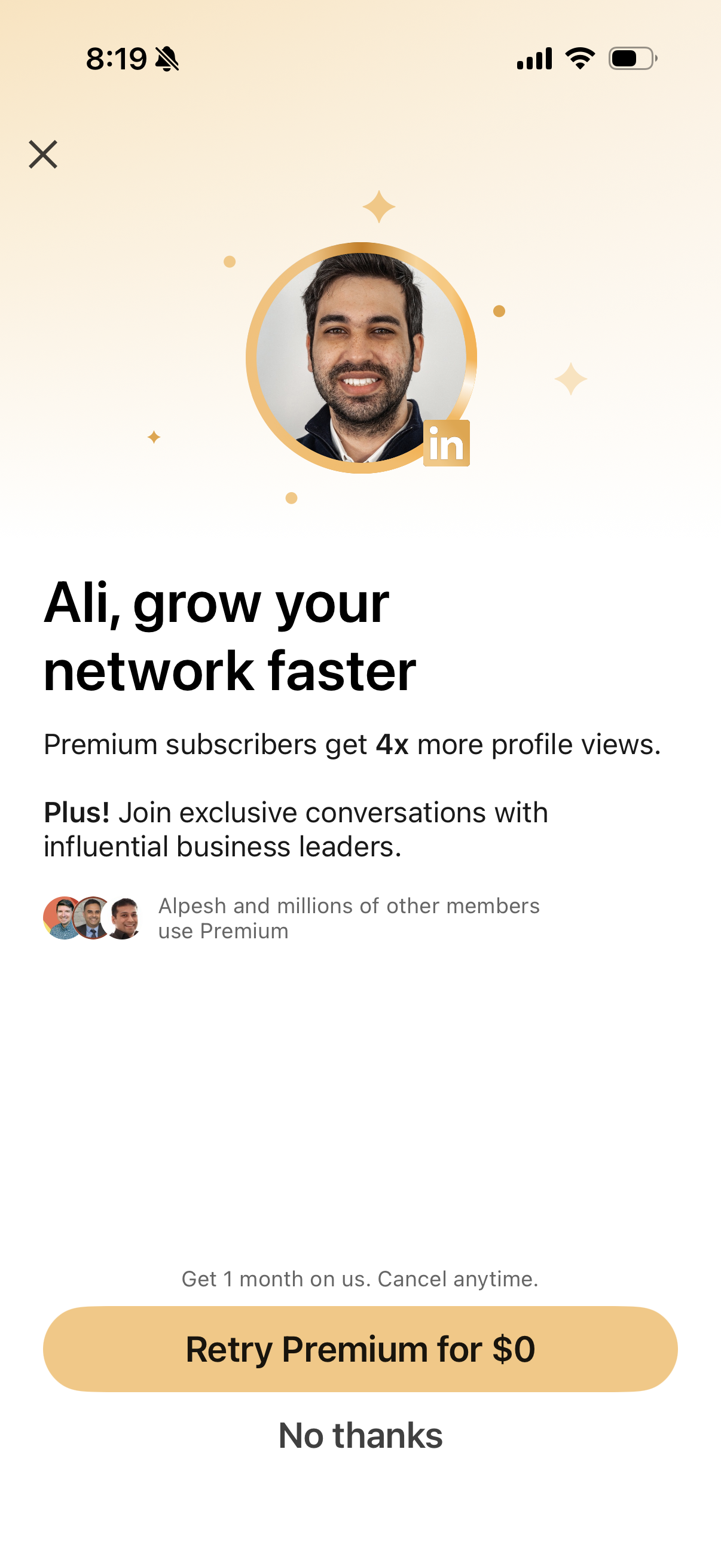
Linkedin1206 × 2622opens the full image 
Any Do1179 × 2556opens the full image 
Reader1206 × 2622opens the full image 
Clime1206 × 2622opens the full image
The numbers
| # | Stat | Computed from |
|---|---|---|
| [1] | 30 of 48 apps (63%) with discount/offer language on cancel screens | save_offer_offer_language |
| [2] | 0 of 48 apps show pause save-offer on cancel screens | save_offer_pause |
| [3] | 0 of 48 apps show downgrade/cheaper-plan save-offer | save_offer_downgrade |
| [4] | 401 genuine cancel-intent screenshots across 48 apps | genuine_cancel_intent_subset |
| [5] | Headway 'trial expired' modal offering 33% discount to renew | qualitative / headway discount-to-retain |
Methodology
Universe: 48 apps whose cancel-category screenshots literally mention 'cancel' (401 screenshots), July 2026. Method: company-level presence of tactic keywords in vision descriptions. Caveat: zeros reflect absence in captured text, not confirmed absence in product.
Sources
- [1]
Lazyweb Research analysis of 48 apps (genuine cancel-intent screens), July 2026
Company-level presence of discount/offer language on cancel screens.
- [2]
Lazyweb Research analysis of 48 apps (genuine cancel-intent screens), July 2026
Pause language absent in captured cancel vision text; absence, not proof of no offer.
- [3]
Lazyweb Research analysis of 48 apps (genuine cancel-intent screens), July 2026
Downgrade/cheaper-plan language absent in captured cancel vision text.
Source: Lazyweb Research — proprietary analysis of real, in-market app screens. Cite as Lazyweb Research, 2026-07-07.