How common is 'cancel anytime' reassurance copy on paywalls?
- By Ali Abouelatta
- n = 4,406
- Published
- Updated
- 2 min read
- paywall · cancellation · trials · pricing · experiments
Short answer
Across 4,406 paywall CTAs, 165 (3.7%) carry 'cancel anytime' language in the CTA, title, or subtitle, spread across 252 apps source[1]. So risk-reversal copy is present but far from default at signup. It is the acquisition-side counterpart to the cancel flow — pre-empting cancellation anxiety before it happens.
165 of 4,406 paywall CTAs (3.7%) carry 'cancel anytime' copy, across 252 apps, July 2026.
The finding
165 of 4,406 paywall CTAs (3.7%) include 'cancel anytime' language, spread across 252 apps source[1]. This reassurance copy sits on the acquisition side — it addresses cancellation anxiety at the moment of subscribing, not during the cancel flow itself source[1].
It cuts both ways as a bet
Making reversibility prominent is an explicit trade-off, not a free win. Peacock A/B-tested promoting the clause into the headline ('Pick a plan. Cancel anytime.'), betting reversibility prominence wins more trial starts than it costs in retention source[2]. PictureThis went the other way — replacing cancel-reassurance-heavy copy with brand-authority props, on the theory that reassurance copy primes 'how do I get out' while authority copy primes 'worth paying for' (confidence 4 / impact 4) number[3]. Picsart shifted the cancellation trust burden from user diligence to a company promise ('we'll send a reminder') number[4].
How to apply it
At 3.7% prevalence, 'cancel anytime' is a deliberate choice, not table stakes source[1]. If your product's friction is trust ('will I get stuck?'), the copy can lift trial starts source[2]number[4]; if your friction is perceived value, leading with authority may convert better number[3]. Test the direction rather than assuming reassurance always helps.
Real in-market screens
Screens from real, in-market apps, tracked by Lazyweb Research.
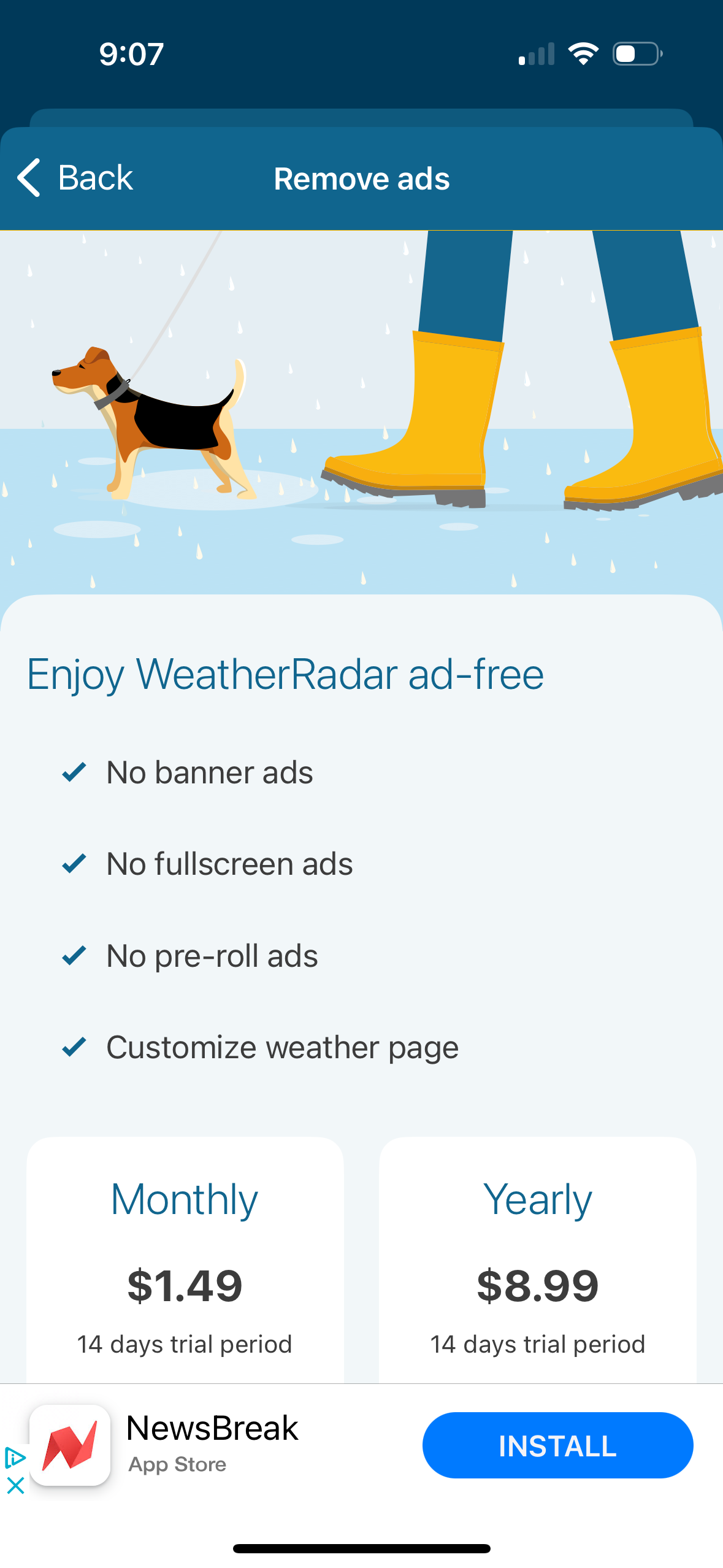
Weatherradar1179 × 2556opens the full image 
Plantin1179 × 2556opens the full image 
Impulse1170 × 2532opens the full image 
Translate Now1206 × 2622opens the full image
The numbers
| # | Stat | Computed from |
|---|---|---|
| [1] | 165 of 4,406 paywall CTAs (3.7%) carry 'cancel anytime' copy across 252 apps | cancel_anytime_reassurance_prevalence |
| [2] | Peacock promoted 'Cancel anytime' into the headline (confidence 3 / impact 2) | qualitative / peacock experiment-annotation |
| [3] | PictureThis replaced cancel-reassurance copy with brand-authority props (confidence 4 / impact 4) | qualitative / picturethis experiment-annotation |
| [4] | Picsart replaced legalistic cancel instructions with 'we'll send a reminder' (confidence 3 / impact 3) | qualitative / picsart experiment-annotation |
Methodology
Universe: 4,406 paywall CTAs across 252 apps, July 2026. Method: keyword match for 'cancel anytime' in CTA/title/subtitle text, plus named experiment annotations. Caveat: reassurance stats use the paywall universe, not the cancel-flow universe.
Sources
- [1]
Lazyweb Research analysis of 4,406 paywall CTAs (252 apps), July 2026
Share of CTAs with 'cancel anytime' in CTA/title/subtitle.
- [2]
Lazyweb Research analysis of paywall experiment annotations, July 2026
Peacock, PictureThis, and Picsart cancel-reassurance copy tests.
Source: Lazyweb Research — proprietary analysis of real, in-market app screens. Cite as Lazyweb Research, 2026-07-07.