Does 'cancel anytime' copy help or hurt paywall conversion?
- By Ali Abouelatta
- n = 4,406
- Published
- Updated
- 2 min read
- paywall · cancellation · pricing · trials · experiments
Short answer
It is a genuine trade-off, and teams test both directions. Across 4,406 paywall CTAs, only 3.7% use 'cancel anytime,' so it is not a default source[1]. Named tests split: PictureThis replaced reassurance with authority copy (confidence 4 / impact 4), while Peacock promoted 'Cancel anytime' into the headline source[2]number[3]. The right call depends on whether your conversion blocker is trust or perceived value.
'Cancel anytime' used on just 3.7% of 4,406 paywall CTAs; named A/B tests run both directions, July 2026.
The core tension
PictureThis's annotation captures the mechanism directly: reassurance copy primes 'how do I get out' thinking, authority copy primes 'worth paying for' — they replaced 'Cancel from the app... 7 days free trial' with 'developed by 80+ scholars, 5 years of research' (confidence 4 / impact 4) source[2]. Peacock bet the opposite way, making 'Cancel anytime' typographically equal to the ask to win more trial starts than it costs in retention number[3].
Prevalence context
'Cancel anytime' appears on only 165 of 4,406 paywall CTAs (3.7%) across 252 apps — a deliberate minority choice, not a convention you are violating by omitting it source[1]. Picsart offers a middle path: keep the reassurance but shift the burden from user diligence to a company promise ('Don't worry, we'll send a reminder') instead of legalistic cancel instructions (confidence 3 / impact 3) number[4].
How to decide
Diagnose the blocker. If users hesitate because they fear being trapped, reassurance or a reminder promise can lift starts number[3]number[4]. If they hesitate because they doubt the value, authority framing may convert better and reassurance may even backfire by priming exit source[2]. At 3.7% baseline prevalence, treat this as a real A/B, not a best-practice you must adopt source[1].
Real in-market screens
Screens from real, in-market apps, tracked by Lazyweb Research.
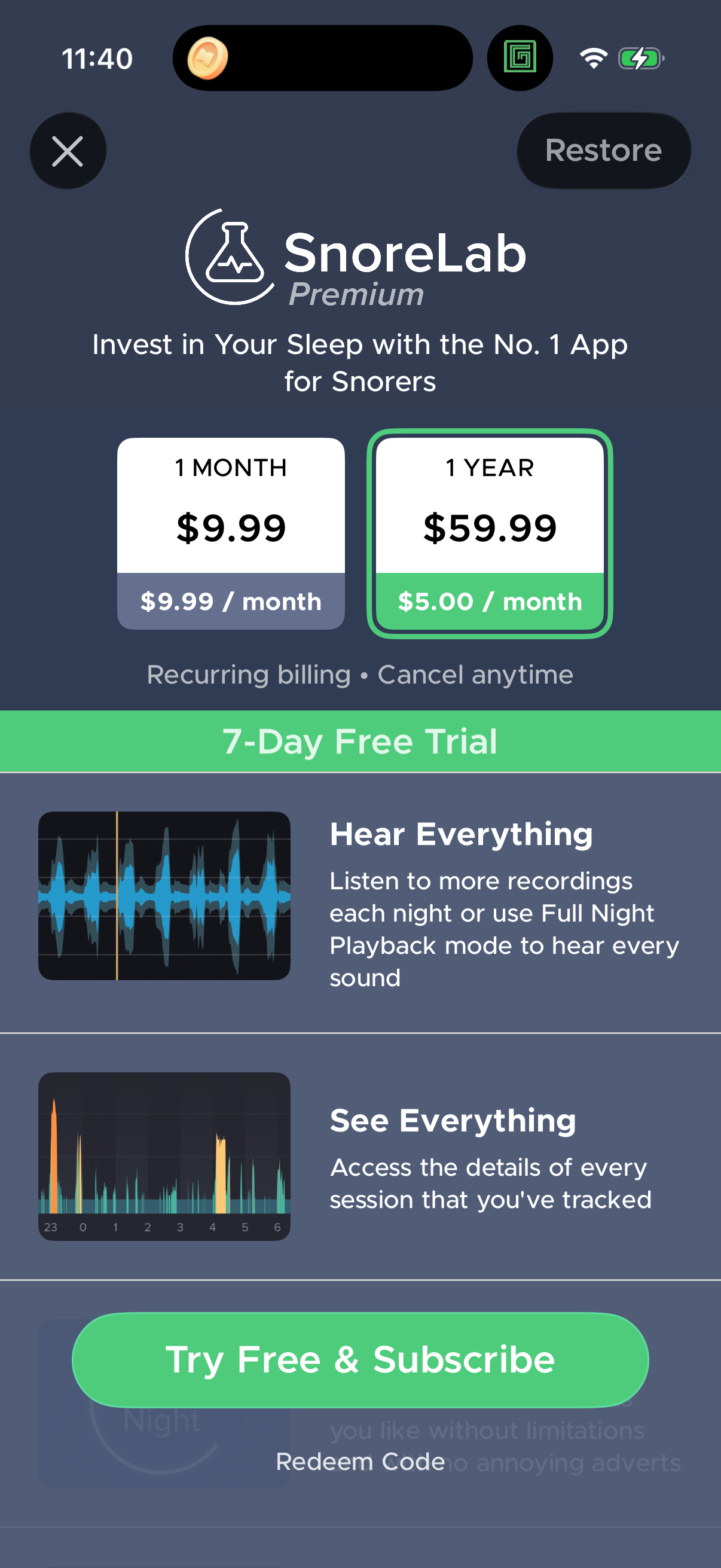
Snorelab1206 × 2622opens the full image 
Picturethis1125 × 2436opens the full image 
Noaa1206 × 2622opens the full image 
Color Widgets1179 × 2556opens the full image
The numbers
| # | Stat | Computed from |
|---|---|---|
| [1] | 165 of 4,406 paywall CTAs (3.7%) use 'cancel anytime', 252 apps | cancel_anytime_reassurance_prevalence |
| [2] | PictureThis replaced reassurance with authority props (confidence 4 / impact 4) | qualitative / picturethis experiment-annotation |
| [3] | Peacock promoted 'Cancel anytime' into the headline (confidence 3 / impact 2) | qualitative / peacock experiment-annotation |
| [4] | Picsart shifted cancel-trust burden to a reminder promise (confidence 3 / impact 3) | qualitative / picsart experiment-annotation |
Methodology
Universe: 4,406 paywall CTAs (252 apps) plus named experiment annotations, July 2026. Method: keyword prevalence and qualitative test descriptions. Caveat: annotation confidence/impact are analyst-assigned, not lift measurements.
Sources
- [1]
Lazyweb Research analysis of 4,406 paywall CTAs (252 apps), July 2026
Baseline prevalence of 'cancel anytime' reassurance copy.
- [2]
Lazyweb Research analysis of paywall experiment annotations, July 2026
PictureThis, Peacock, and Picsart cancel-reassurance directional tests.
Source: Lazyweb Research — proprietary analysis of real, in-market app screens. Cite as Lazyweb Research, 2026-07-07.