How common is an 'are you sure' confirmation step when cancelling?
- By Ali Abouelatta
- n = 48
- Published
- Updated
- 2 min read
- cancellation · retention · ux-patterns · checkout · saas
Short answer
A confirmation ('are you sure / confirm cancel') step appears in 12 of 48 apps with genuine cancel-intent screens (25%) source[1]. A separate keep/stay retention CTA shows up in 10 of 48 apps (21%) source[2]. So roughly a quarter of apps add a confirm friction step, and a fifth surface an explicit 'keep subscription' option.
25% of cancel-flow apps add a confirm step; 21% surface a keep/stay CTA, July 2026.
Prevalence of friction and retention steps
About one in four apps inserts a confirmation step, and about one in five offers an explicit keep/stay action on the cancel path source[1]source[2].
How the two interact
A confirmation step and a keep/stay CTA are distinct levers: one adds a deliberate 'are you sure' pause, the other offers a positive alternative to cancelling source[1]source[2]. In named flows they combine with loss-aversion — Instacart+ warns users they'll lose benefits on a date before the final confirm button source[3]. The keep/stay CTA is also where button-styling matters: cancel-family CTAs skew dismiss/secondary while the keep path takes primary weight number[4].
How to apply it
A single confirmation step is common enough (25%) to be defensible, but stacking confirm + survey + offer + retention CTA pushes you toward the deep tail of the funnel source[1]source[2]. Keep any confirmation genuinely informative (e.g. the loss-of-benefits date) rather than a pure speed bump, and make sure the confirm button that actually cancels is reachable, not dismiss-weighted source[3]number[4].
Real in-market screens
Screens from real, in-market apps, tracked by Lazyweb Research.

Fitbod1179 × 2556opens the full image 
Any Do1179 × 2556opens the full image 
Plantin1179 × 2556opens the full image 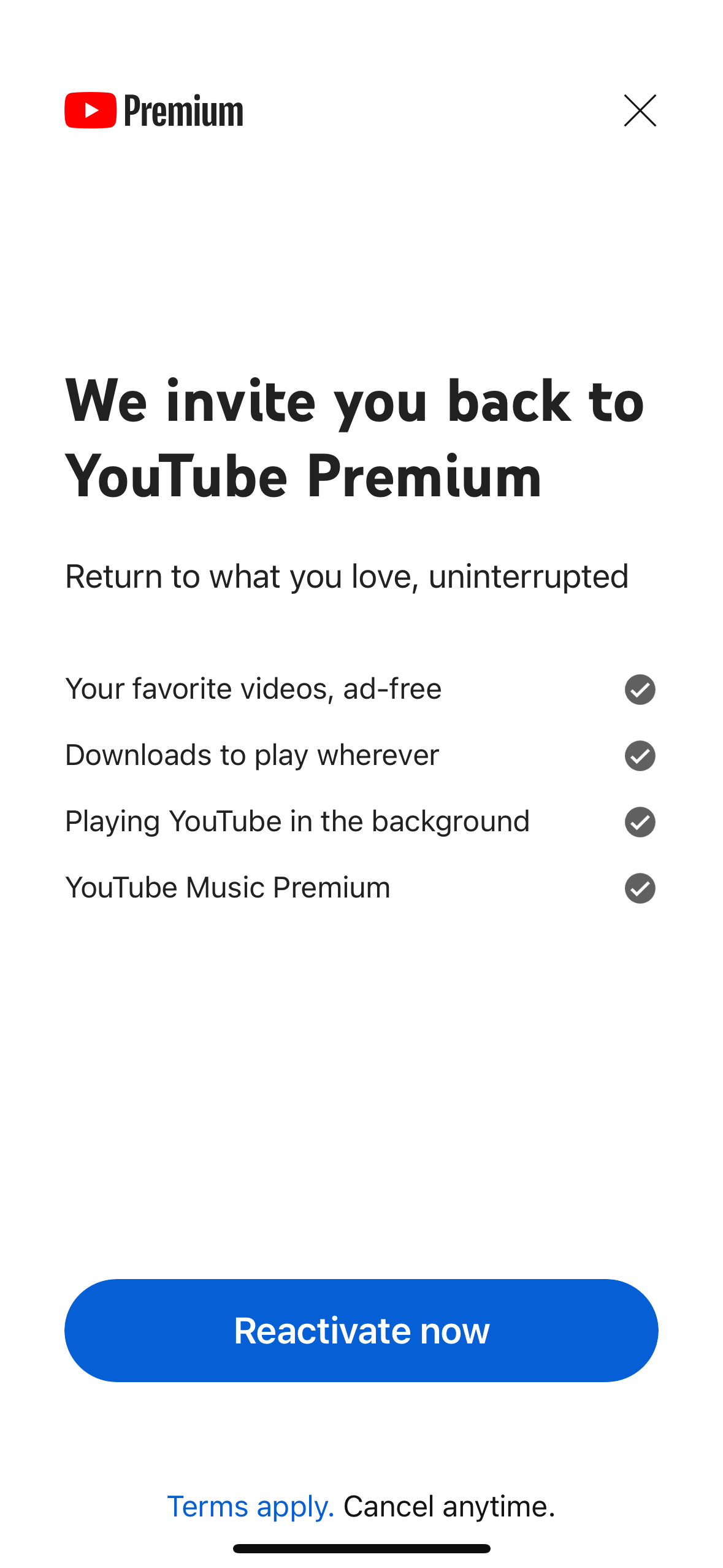
Youtube1179 × 2556opens the full image
The numbers
| # | Stat | Computed from |
|---|---|---|
| [1] | 12 of 48 apps (25%) show a confirm/'are you sure' step | confirmation_dialog |
| [2] | 10 of 48 apps (21%) show a keep/stay retention CTA | keep_stay_cta |
| [3] | Instacart+ warns 'you'll lose benefits on [date]' before final confirm | qualitative / instacart cancel-flow-screen |
| [4] | Cancel/keep CTAs skew dismiss/secondary (40/18) vs 7 primary | cancel_flow_cta_roles |
Methodology
Universe: 48 apps with genuine cancel-intent screens (401 screenshots), July 2026. Method: company-level keyword presence for confirmation and keep/stay language. Caveat: presence based on captured vision text; may undercount steps not visible in screenshots.
Sources
- [1]
Lazyweb Research analysis of 48 apps (genuine cancel-intent screens), July 2026
Company-level presence of a confirmation step.
- [2]
Lazyweb Research analysis of 48 apps (genuine cancel-intent screens), July 2026
Company-level presence of a keep/stay retention CTA.
- [3]
Lazyweb Research analysis of 401 cancel-intent screenshots (48 apps), July 2026
Instacart+ loss-aversion confirmation vision description.
Source: Lazyweb Research — proprietary analysis of real, in-market app screens. Cite as Lazyweb Research, 2026-07-07.