How do apps frame single-feature utility gates (pay to unlock just this)?
- By Ali Abouelatta
- n = 809
- Published
- Updated
- 2 min read
- paywall · upsell · pricing · trials · mobile · monetization
Short answer
Single-feature gates isolate one feature behind an unlock/Continue CTA and are best understood through observed experiments rather than a single prevalence number: unlock CTAs overall appear in 20% of 809 apps (159/809).source[1] Two observed changes illustrate the pattern — NOAA raised a single weather feature's weekly price from $5.99 to $9.99 while keeping the same layout, and AllTrails swapped a 50% discount for a 7-day trial on its offline-map gate.source[5] The frame stays constant; only price or offer moves.
Unlock CTAs — the backbone of single-feature gates — appear in 20% of tracked apps (159/809) — Lazyweb Research, July 2026.
Finding: isolate the feature, hold the frame
The defining trait of a single-feature utility gate is that it gates exactly one capability behind an unlock/Continue action, letting the team tune price or offer without disturbing the surrounding flow. Unlock CTAs — the mechanic these gates rely on — are used by 159 of 809 apps (20%).source[1]
Observed single-feature-gate experiments:source[5]
| App | Feature gate | Change |
|---|---|---|
| NOAA (Current Fires) | Weather utility | Weekly price $5.99 -> $9.99, same unlock layout + Continue CTA |
| AllTrails | Offline maps | 50% discount -> 7-day trial, lower annual price, trial timeline |
How to apply
When you gate a single utility, keep the layout and CTA fixed so you can cleanly test the offer. NOAA's approach shows how a stable frame lets you isolate price sensitivity — change only the number, not the surrounding conversion structure.source[5] AllTrails shows the alternative lever: swap a discount for a benefit-led trial to lower commitment risk while keeping the feature promise next to the action.source[5]
Caveats
The named changes are observed before/after UI diffs with inferred rationale, not measured lift.source[5] The 20% unlock-CTA figure is a corpus-wide, company-deduped lower bound from LLM tags and covers all unlock CTAs, not only single-feature gates.source[1]
Real in-market screens
Screens from real, in-market apps, tracked by Lazyweb Research.

Hinge Health1206 × 2622opens the full image 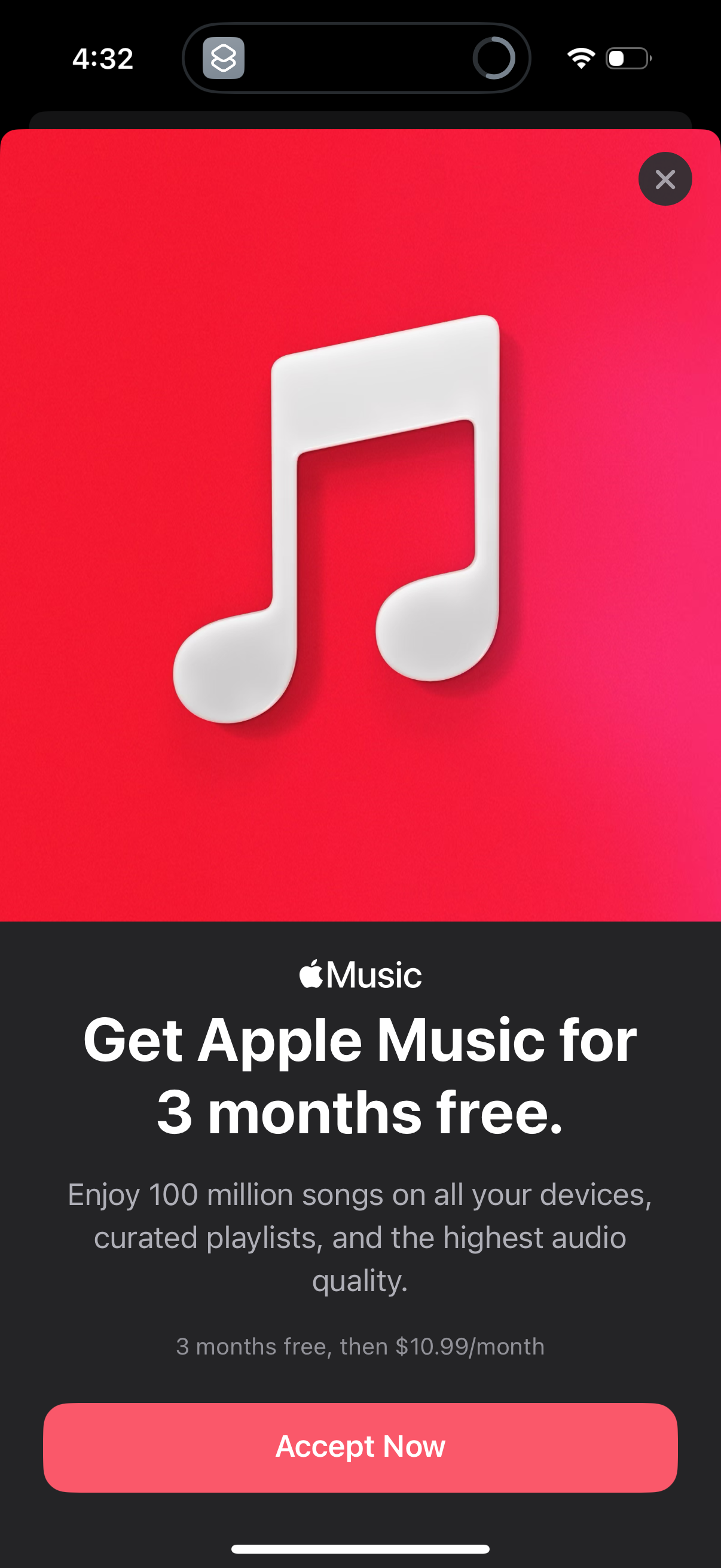
Apple Music1206 × 2622opens the full image 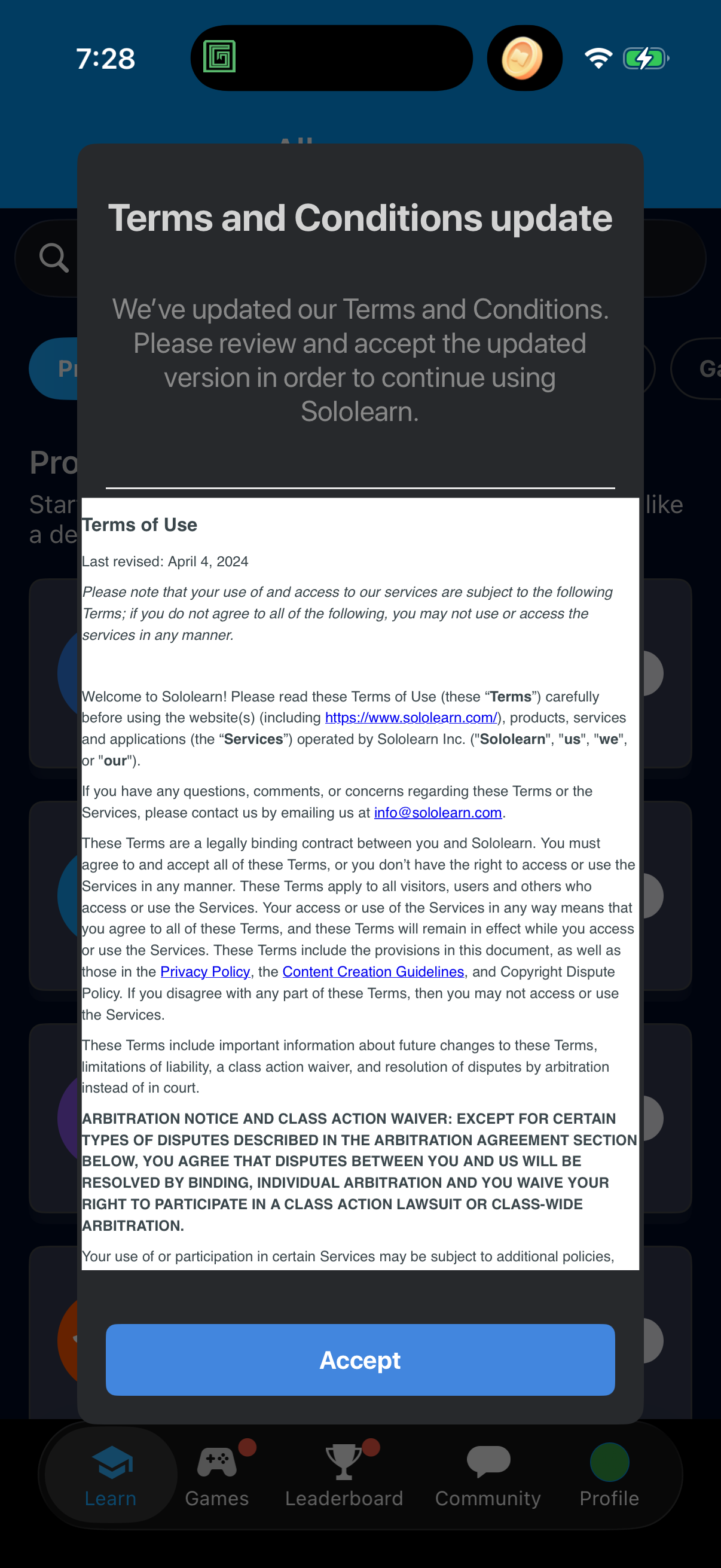
Sololearn1206 × 2622opens the full image 
The Realreal1179 × 2556opens the full image
The numbers
| # | Stat | Computed from |
|---|---|---|
| 01 | 20% (159/809)s1 | unlock_cta_prevalence: 159/809 |
| 02 | 622 of 4,814s2 | gating_experiments_count: 622/4,814 (context for named examples) |
Methodology
Universe: 809 tracked mobile apps (unlock-CTA prevalence) plus named observed experiments. Method: company-deduped tag prevalence and detected UI diffs, July 2026. Caveat: named changes are observations with inferred rationale, not measured lift.
Sources
- [1]
Lazyweb Research analysis of 809 apps (tracked mobile app corpus with screenshots), July 2026
Prevalence deduped by COUNT(DISTINCT company_name) over 44,873 tagged screenshots; tag patterns are LLM synonym phrases (tightened after spot-checking) so every stat is a lower bound.
- [5]
Lazyweb Research analysis of 4,814 detected UI experiments (tracked app corpus), July 2026
Experiments are detected before/after UI diffs with LLM-inferred rationale, deduped by COUNT(DISTINCT experiment_id); these are observed changes, not measured A/B lift.
Source: Lazyweb Research — proprietary analysis of real, in-market app screens. Cite as Lazyweb Research, 2026-07-07.