Should the Paywall Come Before or After Onboarding?
- By Ali Abouelatta
- n = 40
- Published
- Updated
- 2 min read
- paywall · onboarding · monetization · ux-patterns · trials
Short answer
Across 40 onboarding flows with a paywall tracked by Lazyweb Research, 77.5% (31 of 40) place the first paywall in the final third of the flow and 0 place it on the first step source[1]. The revealed-preference answer is clear: apps put the paywall after onboarding, not before. The mean first-paywall position is 0.82 of the way through the flow source[2].
0 of 40 paywalling onboarding flows open with the paywall; 77.5% put it in the final third, Lazyweb Research, July 2026 (N=40).
Bar chart · Share
Share — Front-loaded paywalls are rare
One block is about 2.8%
- Before ~one-third mark
- 2.5%
- Middle of flow
- 20%
- After ~two-thirds mark
- 77.5%
The finding
Not a single one of the 40 paywalling onboarding flows opens with the paywall as the first step source[1]. Instead, 31 of 40 (77.5%) place the first paywall in the final third of onboarding, and 11 of 40 (27.5%) place it on the very last step source[1]. The mean first-paywall relative position is 0.822 and the median is 0.894 source[2].
Front-loaded paywalls are rare
| Placement | Flows | Share |
|---|---|---|
| Before ~one-third mark | 1 | 2.5% |
| Middle of flow | 8 | 20% |
| After ~two-thirds mark | 31 | 77.5% |
Only 1 flow of 40 paywalls in the opening third source[1]. Even the earliest real examples — Adobe at step 3 of 13, Canva and FaceApp near the midpoint — still let the user complete some onboarding first source[3].
How to apply it
The corpus supports an 'onboard, then paywall' sequence: deliver perceived value (personalization, a plan reveal, a first result) before asking for money. The screen just before the paywall is a generic onboarding screen in 28 of 40 flows source[3], reinforcing that the paywall is a natural terminal step rather than a gate. A before-onboarding paywall is a deliberate contrarian bet, matched by roughly 1 in 40 tracked flows source[1].
Caveats
This describes where apps place paywalls, not which placement converts best — the corpus has no attached conversion outcomes. N is 40 flows and detection is a floor because the paywall flag is sparse source[4].
Real in-market screens
Screens from real, in-market apps, tracked by Lazyweb Research.
Alexa1206 × 2622opens the full image 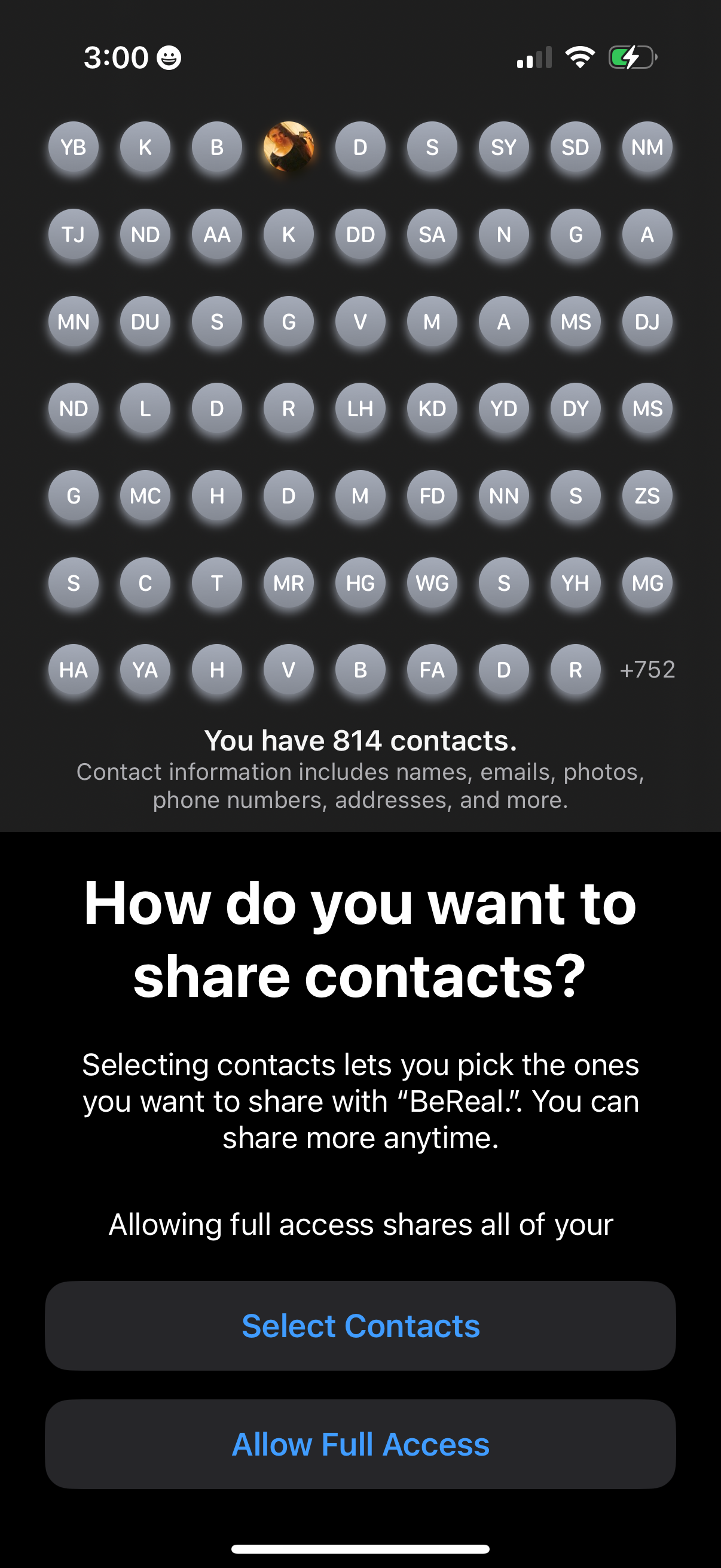
Bereal1206 × 2622opens the full image 
Grok1206 × 2622opens the full image 
Falou1170 × 2532opens the full image
The numbers
| # | Stat | Computed from |
|---|---|---|
| [1] | final third 31/40 (77.5%); last step 11/40; first step 0/40; first third 1/40 | first_paywall_thirds_distribution |
| [2] | first paywall mean 0.822 / median 0.894 | first_paywall_relative_position |
| [3] | preceding screen generic in 28/40; Adobe step 3/13, Canva/FaceApp ~0.50 | qualitative |
| [4] | 40 of 129 flows; is_paywall NULL on 21,824/23,407 screens | onboarding_flows_with_paywall / universe |
Methodology
Universe: 40 onboarding flows with a paywall across ~800 tracked apps, July 2026; positions computed with ROW_NUMBER over flow steps. Caveat: placement frequency, not conversion outcome, and N=40.
Sources
- [1]
Lazyweb Research analysis of 40 onboarding flows (~800 tracked apps), July 2026
First-paywall relative position bucketed into thirds; first-step and last-step counts.
- [2]
Lazyweb Research analysis of 40 onboarding flows (~800 tracked apps), July 2026
Mean and median first-paywall relative position.
- [3]
Lazyweb Research qualitative review of 40 onboarding flows (~800 tracked apps), July 2026
Preceding-screen categories and early-paywall company examples.
- [4]
Lazyweb Research analysis of 129 onboarding flows (~800 tracked apps), July 2026
40 of 129 flows carry a detected paywall; the flag is sparse so this is a floor.
Source: Lazyweb Research — proprietary analysis of real, in-market app screens. Cite as Lazyweb Research, 2026-07-07.