Do Fintech Apps Offer Social Login at Signup?
- By Ali Abouelatta
- n = 20
- Published
- Updated
- 2 min read
- signup · ux-patterns · saas · mobile · onboarding
Short answer
Across 20 finance apps tracked by Lazyweb Research, only 1 shows Apple sign-in and 2 show Google — social login is nearly absent in fintech versus roughly half of the overall corpussource[1]. Email dominates (10 of 20) with phone second (5 of 20)source[1]. If you build a finance product, an email-and-phone auth screen matches the vertical far better than a social-button stack.
Only 1 of 20 finance apps offers Apple sign-in and 2 offer Google — vs ~half the overall corpus — Lazyweb Research, July 2026.
Bar chart · Finance apps (n=20)
Finance apps (n=20) — Breakdown
One block is about 0.4 Finance apps (n=20)
- Apple
- 1
- 2
- 10
- Phone / OTP
- 5
- Guest
- 1
The finding
Among 20 finance apps with vision-covered auth screens, provider counts are: Apple 1, Google 2, email 10, phone 5, guest 1source[1]. Against a corpus where Google appears on 48.8% and Apple on 43.6% of companiessource[2], fintech is a clear outlier — social login shows up on only 1-2 of 20 apps. Finance auth leans on email and phone, the identifiers tied to account verification and compliance.
Breakdown
| Method | Finance apps (n=20) | Overall corpus prevalence |
|---|---|---|
| Apple | 1 | 43.6% |
| 2 | 48.8% | |
| 10 | 72.7% | |
| Phone / OTP | 5 | 26.0% |
| Guest | 1 | 21.5% |
Finance counts are absolute (n=20 < the 70-company threshold), so read them as counts, not percentagessource[1].
How to apply it
Default a fintech signup to email or phone with verification, not a row of social buttons — you will match 18 of 20 tracked peers. Social login can shift account-security and identity assumptions your compliance stack may not want; the corpus shows the vertical has largely opted out. Guest mode is also rare in finance (1 of 20), so don't expect deferred-signup patterns to translate here.
Caveats
n=20 is below the 70-company reporting threshold, so only absolute counts are cited, never fintech percentagessource[1]. Provider presence is vision-extraction-based; an app could support a provider not captured on its screenshot.
Real in-market screens
Screens from real, in-market apps, tracked by Lazyweb Research.

Honey1206 × 2622opens the full image 
Goodrx1206 × 2622opens the full image 
Ask Ai1206 × 2622opens the full image 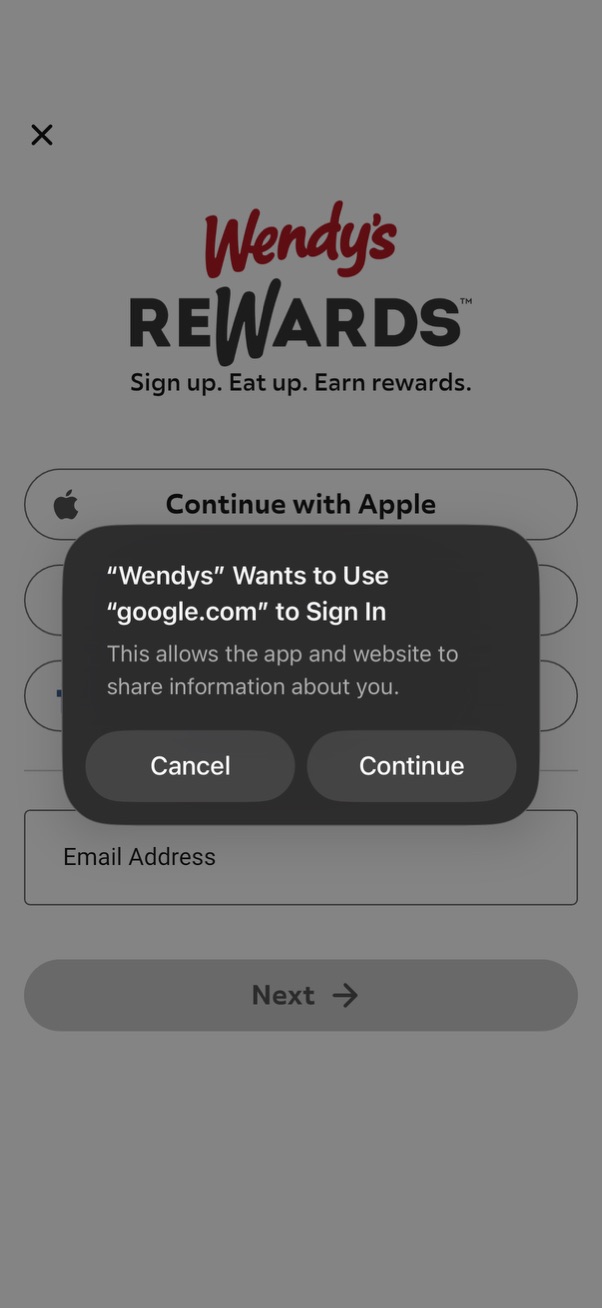
Wendys602 × 1308opens the full image
The numbers
| # | Stat | Computed from |
|---|---|---|
| [1] | Finance n=20: Apple 1, Google 2, email 10, phone 5, guest 1 | vertical_finance stat |
| [2] | corpus Google 48.8%, Apple 43.6%, email 72.7%, phone 26.0%, guest 21.5% | sign_in_with_google/apple/email/phone/guest prevalence stats (denominator 289) |
Methodology
Universe: 20 finance apps within the 289-company vision-covered auth set; absolute provider counts, July 2026. Caveat: small n, absolute counts only, extraction-based.
Sources
- [1]
Lazyweb Research analysis of 20 finance apps (companies with vision-covered auth screens), July 2026
Absolute provider counts per finance company; n<70 so no percentages reported for the vertical.
- [2]
Lazyweb Research analysis of 289 companies with vision-covered auth screens, July 2026
Overall corpus provider prevalence for comparison, de-duplicated by company.
Source: Lazyweb Research — proprietary analysis of real, in-market app screens. Cite as Lazyweb Research, 2026-07-07.
Explore the evidence
- Full 45-frame August 2026 capture
- Three captured screens · August 2026