Should a Signup Screen Offer Both Apple and Google, or Just One?
- By Ali Abouelatta
- n = 289
- Published
- Updated
- 2 min read
- signup · ux-patterns · design · saas · mobile
Short answer
Across 289 companies tracked by Lazyweb Research, 38% offer both Apple and Google sign-in, while 46% show no big-three social login at allsource[1]. Only 10% are Google-only and 5% Apple-only — offering exactly one of the two is the rarest configurationsource[1]. The real decision is less Apple-vs-Google and more whether to include social login at all.
38% of companies offer both Apple and Google sign-in while 46% show no big-three social login at all — across 289 companies tracked by Lazyweb Research, July 2026.
Bar chart · Share
Share — Breakdown
One block is about 1.7%
- Both Apple + Google
- 38.1%
- Google-only
- 10.4%
- Apple-only
- 4.8%
- No big-3 social
- 46.4%
- — of which email-first, no social
- 24.9%
The finding
Among 289 companies with vision-covered auth screens: 38.1% (110) offer both Apple and Google, 10.4% (30) are Google-only, 4.8% (14) are Apple-only, and 46.4% (134) show none of the big-three social providers (Apple, Google, Facebook)source[1]. Of that 134, 72 are email-first with no social login at allsource[1]. Picking exactly one of Apple/Google is the least common pattern in the corpus.
Breakdown
| Configuration | Companies | Share |
|---|---|---|
| Both Apple + Google | 110 | 38.1% |
| Google-only | 30 | 10.4% |
| Apple-only | 14 | 4.8% |
| No big-3 social | 134 | 46.4% |
| — of which email-first, no social | 72 | 24.9% |
Provider prevalence overall: Google appears on 48.8% of companies' auth screens, Apple on 43.6%source[2].
How to apply it
If you commit to social login, offer Apple and Google together — that is what 38% do, and one-sided setups are rare (Apple-only 5%, Google-only 10%). But nearly half of tracked companies skip big-three social entirely, and a quarter are pure email-first, so 'no social login' is a fully mainstream choice, especially in regulated or identity-sensitive verticals.
Caveats
Provider presence is vision-text extraction, not ground truth — an absent match is not proof the app lacks the providersource[2]. Facebook appears on only 22.1% of companies, so the big-three is effectively an Apple/Google story with Facebook as a fading thirdsource[2].
Real in-market screens
Screens from real, in-market apps, tracked by Lazyweb Research.

Prizepicks1206 × 2622opens the full image 
Wizz1206 × 2622opens the full image 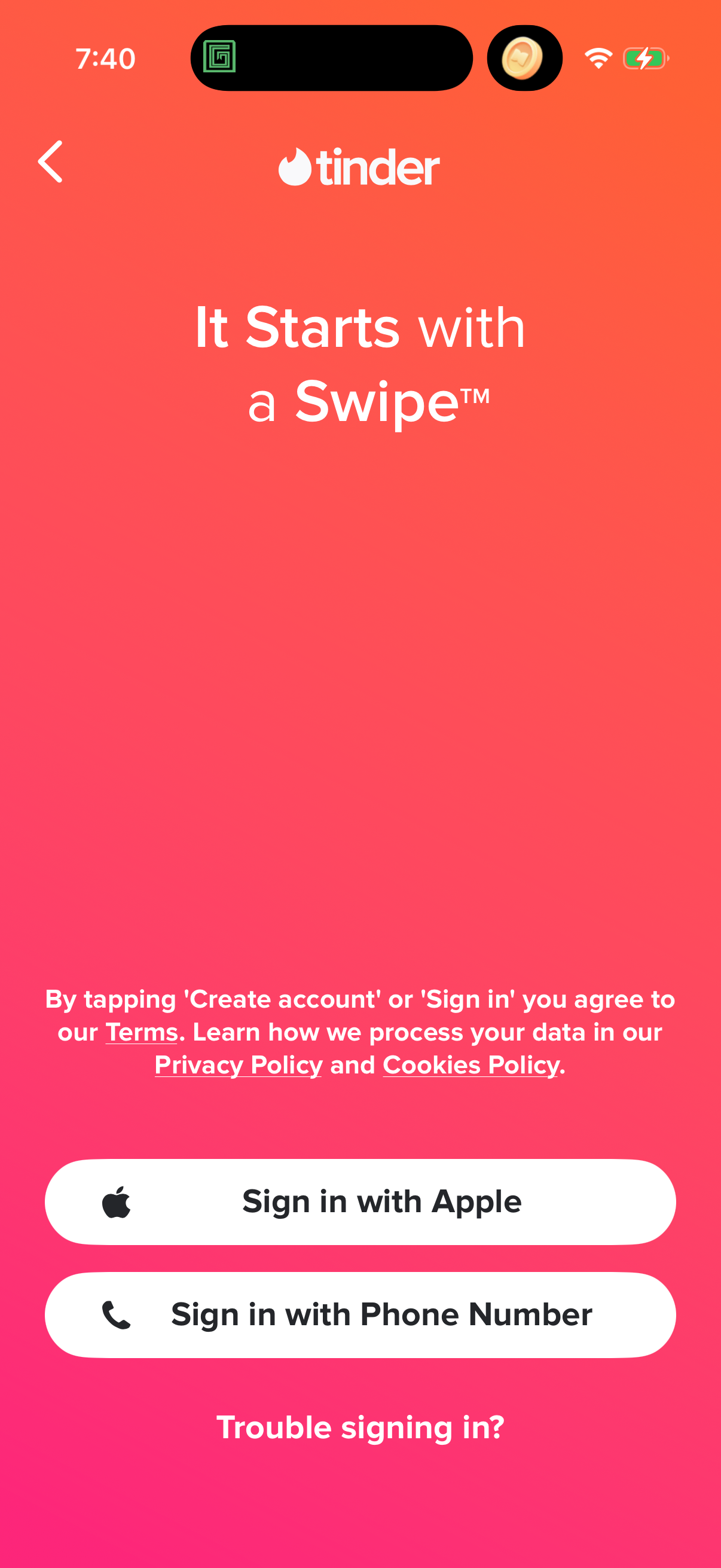
Tinder1206 × 2622opens the full image 
Adobe1179 × 2556opens the full image
The numbers
| # | Stat | Computed from |
|---|---|---|
| [1] | both Apple+Google 110/289 (38.1%); Google-only 30 (10.4%); Apple-only 14 (4.8%); no big-3 social 134 (46.4%); email-first no social 72 (24.9%) | apple_google_pairing stat |
| [2] | Google 141/289 (48.8%); Apple 126/289 (43.6%); Facebook 64/289 (22.1%) | sign_in_with_google_prevalence, sign_in_with_apple_prevalence, facebook_auth_prevalence stats |
Methodology
Universe: 289 companies with vision-extracted auth screens in the Lazyweb corpus; provider combinations from per-company boolean flags, July 2026. Caveat: extraction-based; absence is not proof of absence.
Sources
- [1]
Lazyweb Research analysis of 289 companies with vision-covered auth screens, July 2026
Company-level provider combinations computed via boolean OR per provider across each company's auth screens.
- [2]
Lazyweb Research analysis of 289 companies with vision-covered auth screens, July 2026
Provider prevalence from vision-text regex on captured auth screens; de-duplicated by company.
Source: Lazyweb Research — proprietary analysis of real, in-market app screens. Cite as Lazyweb Research, 2026-07-07.
Explore the evidence
- Full 45-frame August 2026 capture
- Three captured screens · August 2026