Do Most Apps Offer Both Apple and Google Sign In, or Just One?
- By Ali Abouelatta
- n = 289
- Published
- Updated
- 2 min read
- signup · onboarding · mobile · ux-patterns · design
Short answer
Of 289 apps with captured auth screens tracked by Lazyweb Research, 38.1% (110 apps) offer both Apple and Google, while 46.4% (134) show none of the big three social logins.source[1]number[2] Single-provider setups are rarer: 10.4% are Google-only and 4.8% are Apple-only.
38.1% of 289 apps offer both Apple and Google sign-in, while 46.4% show no big-three social login at all (Lazyweb Research, July 2026).
Bar chart · Share of 289
Share of 289 — Provider-combo breakdown
One block is about 1.7%
- Both Apple + Google
- 38.1% [1]
- Google only (no Apple)
- 10.4% [3]
- Apple only (no Google)
- 4.8% [4]
- No big-3 social login
- 46.4% [2]
- — of which email-first, no social
- 24.9% [5]
The finding
Among 289 apps, provider combinations split as follows: 38.1% (110) offer both Apple and Google; 10.4% (30) are Google-only; 4.8% (14) are Apple-only; and 46.4% (134) show none of Apple, Google, or Facebook.source[1]number[2]number[3]number[4] Of that no-social group, 72 apps are email-first with no social option at all.number[5]
Provider-combo breakdown
When an app offers social login at all, offering both providers is by far the most common choice.
How to apply it
The pattern is bimodal: apps tend to either ship the Apple+Google pair (38.1%) or skip social entirely (46.4%), with one-sided setups the exception.source[1]number[2] If you decide to add social login, budget for the pair — Google-only (10.4%) and Apple-only (4.8%) are the uncommon minority, and iOS guidelines push single-provider setups toward the pair anyway.number[3]number[4]
Caveats
Combos are extraction-based per company: 'no big-3 social login' means no Apple/Google/Facebook button was detected on the captured screens, not a guarantee the app lacks them.source[1] Password-entry and mid-flow states without a provider chooser can suppress detection.
Real in-market screens
Screens from real, in-market apps, tracked by Lazyweb Research.

Alltrails1290 × 2796opens the full image 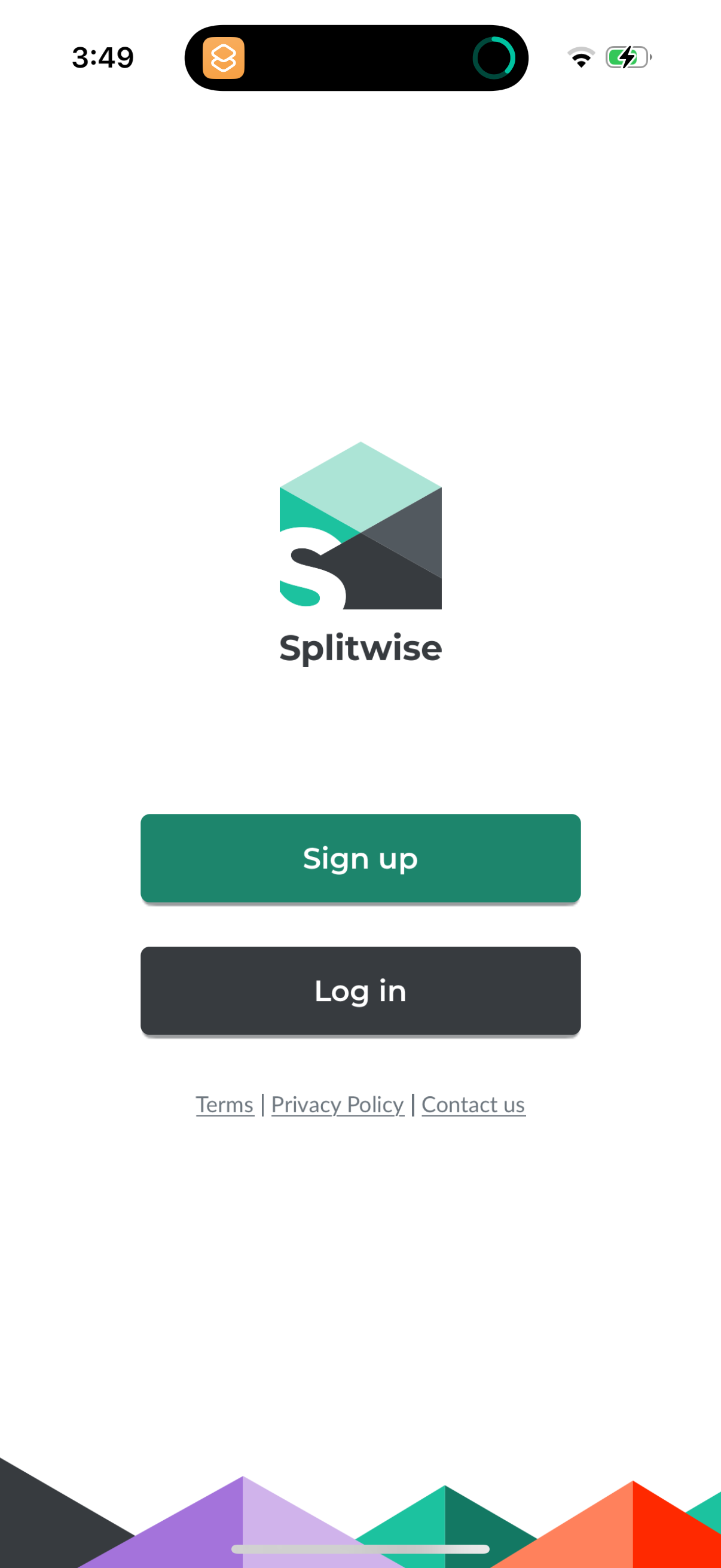
Splitwise1206 × 2622opens the full image 
Sweatcoin1206 × 2622opens the full image 
Geocaching1206 × 2622opens the full image
The numbers
| # | Stat | Computed from |
|---|---|---|
| [1] | 38.1% (110/289) | apple_google_pairing: both Apple+Google |
| [2] | 46.4% (134/289) | apple_google_pairing: no big-3 social login |
| [3] | 10.4% (30/289) | apple_google_pairing: Google-only |
| [4] | 4.8% (14/289) | apple_google_pairing: Apple-only |
| [5] | 72 apps (24.9%) | apple_google_pairing: email-first with no social (72 of 289 = 24.9%) |
Methodology
Universe: 289 mobile apps with a vision-extracted auth screen. Each app classified by which providers were detected across its captured screens (bool_or per provider), July 2026. Extraction-based; a missing detection is not proof of absence.
Sources
- [1]
Lazyweb Research analysis of 289 apps (mobile apps with vision-extracted auth screens), July 2026
Per-company provider-combo classification via bool_or of Apple/Google/Facebook/email detection over captured auth screens; deduped per company.
Source: Lazyweb Research — proprietary analysis of real, in-market app screens. Cite as Lazyweb Research, 2026-07-07.
Explore the evidence
- Full 45-frame August 2026 capture
- Three captured screens · August 2026