What Do Music Apps Change About Their Paywall CTAs?
- By Ali Abouelatta
- n = 63
- Published
- Updated
- 2 min read
- paywall · trials · monetization · experiments · mobile · upsell
Short answer
Across 63 detected paywall CTA changes at 6 music apps tracked by Lazyweb Research, 39 mention trial wording and 26 mention price display.source[1] Because this vertical has fewer than 70 detected changes, Lazyweb reports absolute counts only — no per-vertical percentages.source[2] These are detected UI diffs with inferred rationale, not measured A/B lift.
Among 63 detected paywall CTA changes at 6 music apps, 39 mentioned trial wording and 26 mentioned price display — counts only, below the percentage threshold (Lazyweb Research, July 2026).
The finding
Music apps account for 63 detected paywall CTA changes across 6 companies.source[1] Of these, 39 mention trial wording and 26 mention price display.source[1] Because 63 falls below Lazyweb's n≥70 threshold for publishing per-vertical percentages, this page reports absolute counts only — do not convert these into rates.source[2] Trial wording clearly outnumbers price mentions in raw counts, consistent with music's free-trial-heavy subscription playbook.
Counts at music apps
| Theme | Changes (of 63) |
|---|---|
| Trial wording | 39 |
| Price display | 26 |
With only 6 companies, these counts are dominated by a small number of apps (e.g. YouTube Music, Apple Music), so read them as directional signals about where music apps focus, not as a representative distribution.number[3]
An observed example
SoundCloud changed its primary CTA from a generic 'Continue' to an explicit 'Try free' — naming the free trial directly in the button.number[4] The inferred rationale is that trial paywalls should name the free trial in the CTA when reducing commitment anxiety is the main job.number[4] This fits the trial-heavy count above.
How to apply it and caveats
For music-app growth teams, the corpus signal is that trial framing is the most-touched surface, more so than price presentation — but the evidence base is small.source[1] With 63 rows across just 6 companies, treat every claim here as anecdote-level; no percentages are published for this vertical.source[2]number[3] All rows are detected UI diffs with inferred rationale, never measured A/B outcomes.
Real in-market screens
Screens from real, in-market apps, tracked by Lazyweb Research.
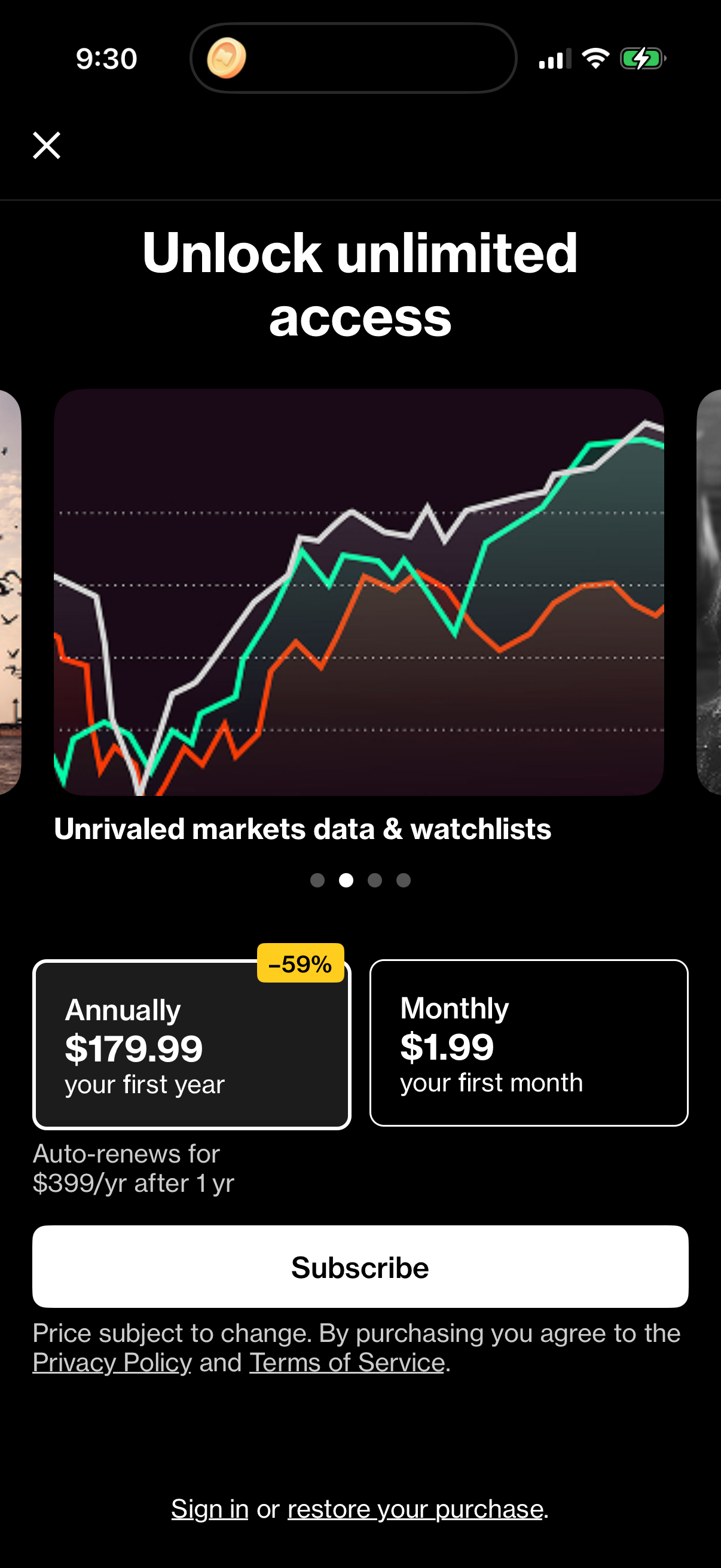
Bloomberg1206 × 2622opens the full image 
Acrobat1125 × 2436opens the full image 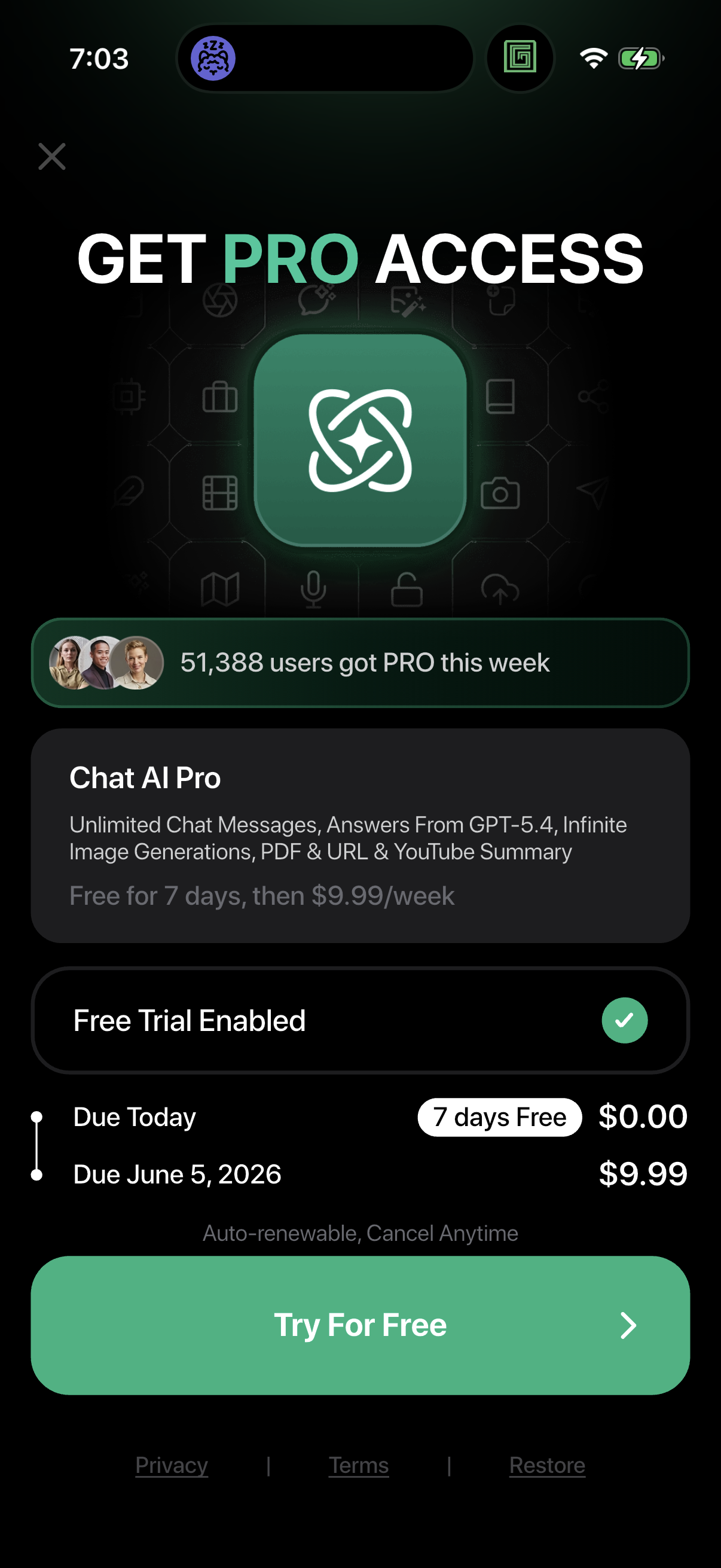
Ask Ai1206 × 2622opens the full image 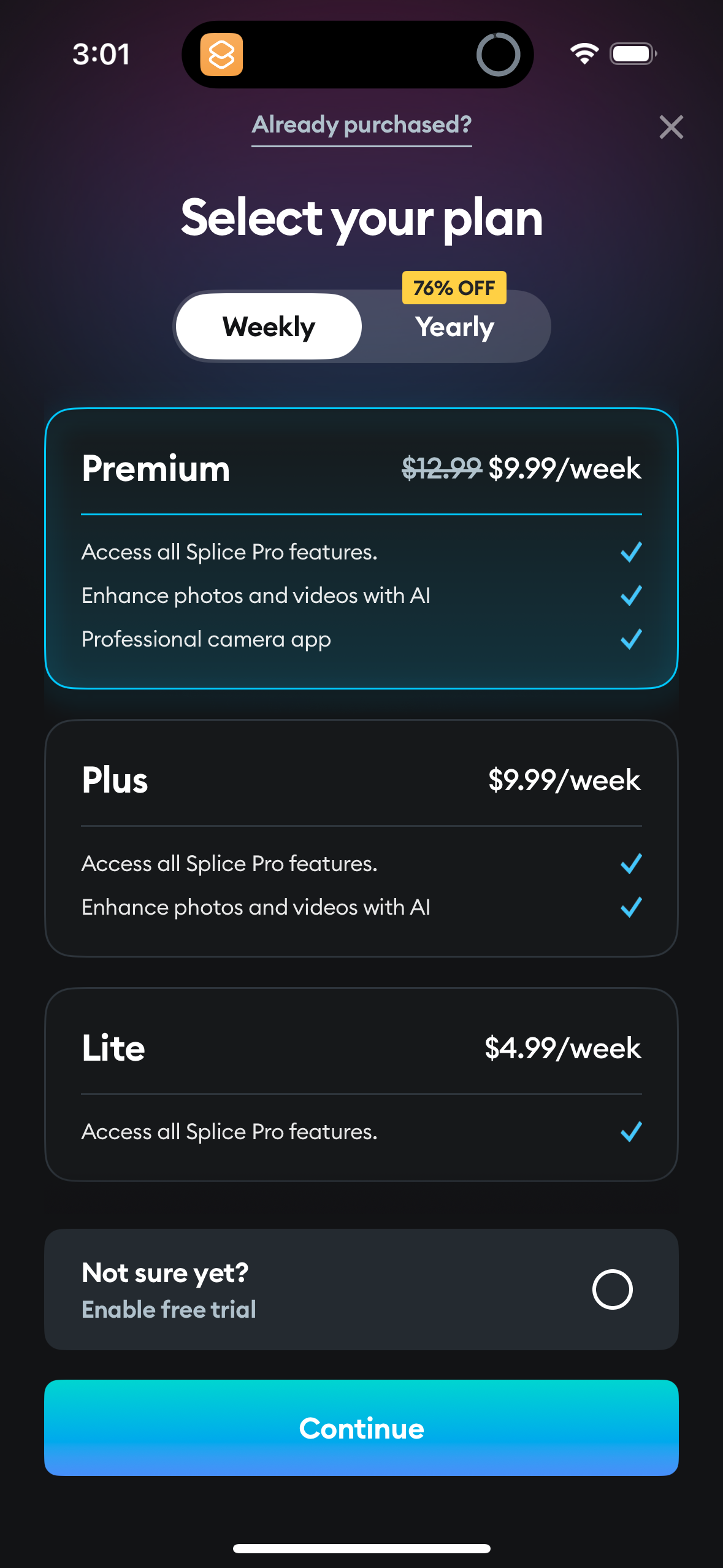
Splice1179 × 2556opens the full image
The numbers
| # | Stat | Computed from |
|---|---|---|
| [1] | Music: 63 changes / 6 companies; 39 trial wording, 26 price display | category_music |
| [2] | Music has 63 rows (<70): counts only, no percentages | smallSampleWarnings.music_threshold |
| [3] | Music has only 6 companies (diversity caveat) | smallSampleWarnings.company_diversity |
| [4] | SoundCloud 'Continue' → 'Try free' | qualitative.CTA verb.soundcloud |
Methodology
Universe: 63 detected before/after paywall CTA changes at 6 music apps in Lazyweb's ~800-tracked-app mobile corpus, July 2026. Below the n≥70 threshold, so absolute counts only — no percentages. Detected UI diffs with inferred rationale, never measured A/B lift.
Sources
- [1]
Lazyweb Research analysis of 63 detected paywall CTA changes at music apps (6 companies), July 2026
paywall_cta_experiments joined to companies.category = 'music'. Counts by regex over LLM-inferred change text; below n≥70, so counts only.
- [2]
Lazyweb Research analysis of 795 detected paywall CTA changes (146 companies), July 2026
Music is below the 70-row vertical threshold and 6-company diversity floor; treated as anecdote-level. Detected UI diffs with inferred rationale, not measured A/B outcomes.
Source: Lazyweb Research — proprietary analysis of real, in-market app screens. Cite as Lazyweb Research, 2026-07-07.