What Secondary CTA Text Appears Most Often on Mobile Paywalls?
- By Ali Abouelatta
- n = 597
- Published
- Updated
- 3 min read
- paywall · monetization · mobile · ux-patterns · design
Short answer
Across 597 secondary paywall CTAs (role-labeled, from a corpus of 2,679 labeled CTAs across ~800 tracked apps), the single most common secondary text is 'view all plans' (34 instances, 10 companies), followed by 'restore' (32, 14 companies) and 'restore purchases' (22, 19 companies) source[1]. Grouped into families, restore-style links (18.9%) and plan-comparison links (18.1%) are neck-and-neck as the dominant secondary affordance source[1]. Legal links ('terms', 'privacy') make up another 14.2% source[1].
'View all plans' (34 instances) and 'restore' (32) are the two most common secondary paywall CTAs among 597 role-labeled secondary CTAs tracked by Lazyweb Research, July 2026.
Bar chart · Share of 597
Share of 597 — Grouped into families
One block is about 0.7%
- Restore (restore / restore purchases / restore subscription)
- 18.9% (113)
- View / see / compare plans
- 18.1% (108)
- Legal links (terms / privacy)
- 14.2% (85)
The finding
Of the 2,679 role-labeled paywall CTAs, 597 are secondary (the smaller, lower-emphasis links that sit below or beside the primary button) source[2]. The top individual secondary strings are 'view all plans' (34 / 10 companies), 'restore' (32 / 14), 'restore purchases' (22 / 19), 'privacy policy' (21 / 14), 'restore subscription' (21 / 2 companies — heavily concentrated in one app), 'see all plans' (20 / 7), 'restore purchase' (18 / 9), 'view other plans' (17 / 2), 'sign in' (14 / 6) and 'terms & conditions' (13 / 4) source[1]. Pair the raw counts with the distinct-company column: 'restore subscription' and 'view other plans' each come mostly from two apps, so they are less generalizable than 'restore purchases,' which spans 19 companies source[1].
Grouped into families
Collapsing casing and phrasing variants gives three clear secondary families source[1]:
| Secondary family | Share of 597 | Companies |
|---|---|---|
| Restore (restore / restore purchases / restore subscription) | 18.9% (113) | 43 |
| View / see / compare plans | 18.1% (108) | 24 |
| Legal links (terms / privacy) | 14.2% (85) | 28 |
Restore links are spread across the most companies (43), which makes 'Restore' the most broadly adopted secondary affordance even though 'view all plans' edges it on raw single-string count source[1].
How to apply it
If you are auditing your own paywall, expect three secondary slots to be standard-issue: a restore link (Apple requires a restore path for non-consumable and subscription purchases), a plan-comparison link, and legal links. The data says restore and plan-comparison are used at nearly identical rates (18.9% vs 18.1%), so neither is a differentiator — their absence is what stands out. 'Sign in' (14 instances) is worth adding when returning subscribers are a meaningful segment source[1].
Caveats
39% of the full 4,406-CTA corpus is role='unknown' and excluded here; every percentage uses the 597 labeled secondary rows or the 2,679 labeled total as its denominator source[3]. Company counts for individual strings are small (2-19), so treat sub-family rankings as directional, not definitive source[1].
Real in-market screens
Screens from real, in-market apps, tracked by Lazyweb Research.
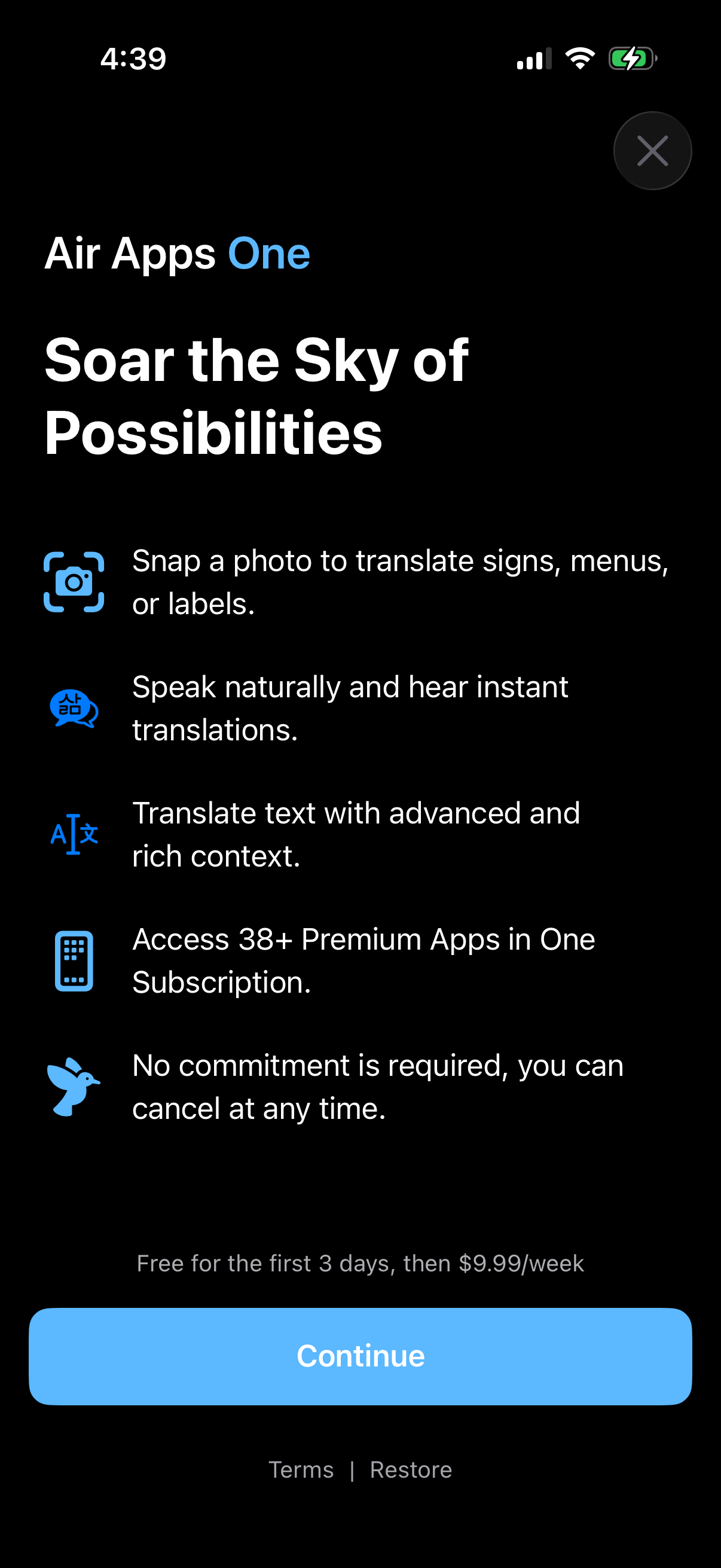
Translate Now1206 × 2622opens the full image 
Mindllama1179 × 2556opens the full image 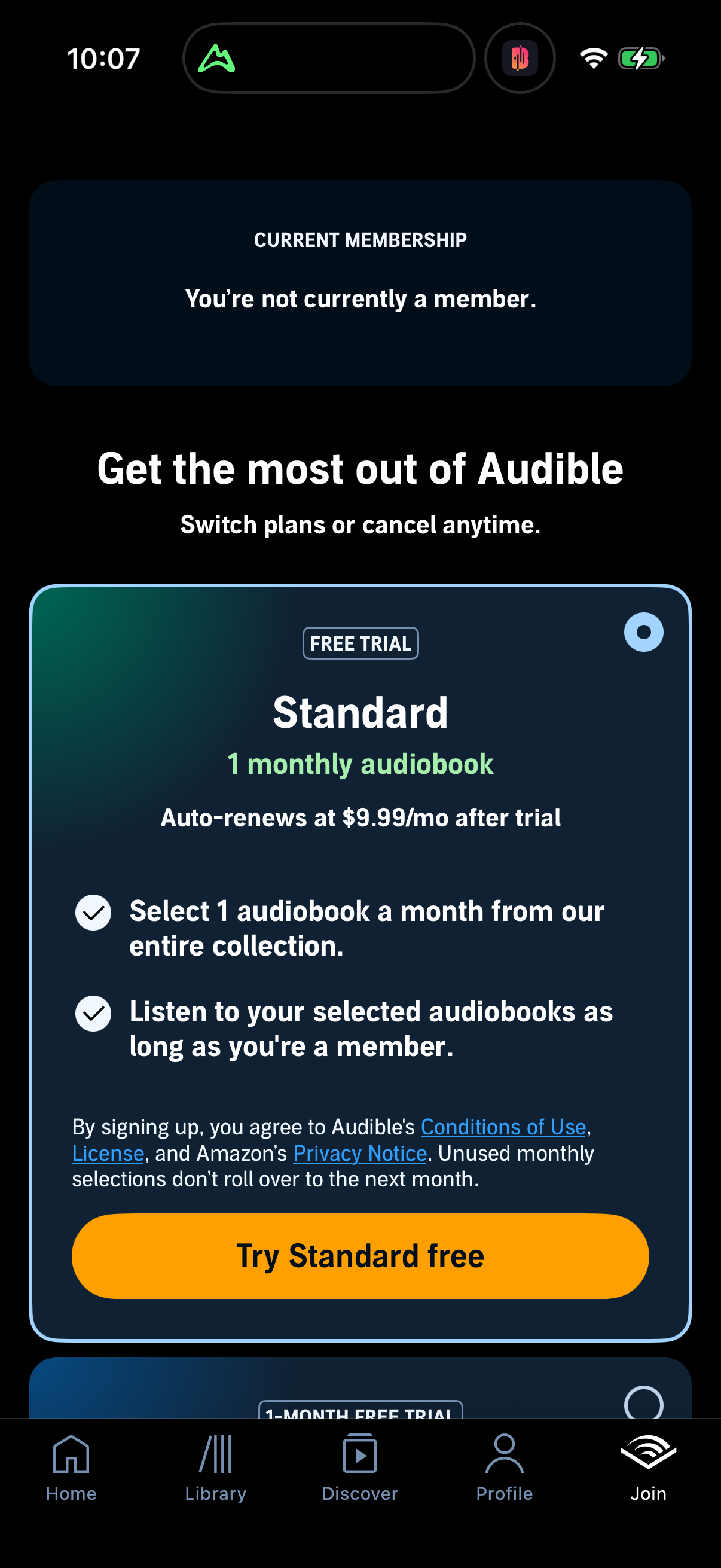
Audible1206 × 2622opens the full image 
Meitu1206 × 2622opens the full image
The numbers
| # | Stat | Computed from |
|---|---|---|
| [1] | view all plans=34 (10 cos); restore=32 (14); restore purchases=22 (19); privacy policy=21 (14); restore subscription=21 (2); see all plans=20 (7); restore purchase=18 (9); view other plans=17 (2); sign in=14 (6); terms & conditions=13 (4); restore family=18.9% (113); view-plans family=18.1% (108); legal links=14.2% (85) | secondary_leaderboard and secondary_families over 597 secondary CTAs |
| [2] | 597 secondary CTAs of 2,679 role-labeled (1,886 primary, 597 secondary, 196 dismiss) | role_distribution |
| [3] | 1,727 of 4,406 CTAs (39%) are role='unknown' | role_distribution / smallSampleWarnings |
Methodology
Universe: 597 role-labeled secondary paywall CTAs among 2,679 labeled (of 4,406 total) extracted from ~800 tracked mobile apps, Supabase pull July 2026. CTA text lowercased and trimmed before counting; family regexes group restore*, view/see/compare plans, and terms/privacy. Caveat: 39% of all CTAs are role='unknown' and excluded.
Sources
- [1]
Lazyweb Research analysis of 597 secondary paywall CTAs (~800 tracked apps), July 2026
Secondary CTA leaderboard and family grouping; casing/phrasing variants merged with lower(trim()); distinct-company counts reported alongside instance counts.
- [2]
Lazyweb Research analysis of 2,679 role-labeled paywall CTAs (~800 tracked apps), July 2026
Role distribution: 1,886 primary, 597 secondary, 196 dismiss.
- [3]
Lazyweb Research analysis of 4,406 paywall CTAs (~800 tracked apps), July 2026
39% of CTAs are role='unknown'; role-based stats use only the 2,679 labeled rows.
Source: Lazyweb Research — proprietary analysis of real, in-market app screens. Cite as Lazyweb Research, 2026-07-07.