Should a countdown timer be paired with the discount?
- By Ali Abouelatta
- n = 751
- Published
- Updated
- 2 min read
- paywall · notifications · monetization · ux-patterns · mobile · pricing
Short answer
In this corpus, countdowns almost never stand alone — the apps that use them weld the timer to an explicit discount and deadline. Drops shows a live countdown (2:03:33:36) above a strikethrough $169.99 → $99.99 'GET 40% OFF,' and Gentler pairs 'Welcome Back!' with 'Offer ends in 0 hours.'source[1]source[2] Genuine offer countdowns are rare (37 of 751 tagged companies, 4.9%), so treat the timer as an amplifier for a real discount, not a standalone tactic.source[3]
Genuine offer countdowns (37 of 751 tagged companies, 4.9%) are almost always welded to an explicit discount — Lazyweb Research, July 2026.
The finding: timer + discount + deadline, together
The countdowns that survive false-positive filtering are bound to a discount. Drops is the exemplar — a live countdown over a strikethrough $169.99 → $99.99 with 'GET 40% OFF,' plus heavy seasonal variants ('Spring sale is back!', 'Last call for 50% off!', 'It's now or never!').source[1] Gentler combines a win-back 'Welcome Back!' with 'Offer ends in 0 hours.'source[2] Only 4.9% of tagged companies run a genuine offer countdown at all, so this is a specialist combination, not a common one.source[3]
How to apply it
If you add a countdown, give it something real to count down to: a stated % off and a genuine expiry, the way Drops binds the clock to '40% OFF' and Gentler binds it to a returning-user offer.source[1]source[2] A ticking timer with no discount behind it is off-pattern here and risks reading as manufactured urgency. Because only 28 of 795 detected experiments even touch countdown/urgency framing, there's little evidence any team found the bare timer worth scaling — keep it reserved for real, expiring deals.source[4]
Caveats
Countdown prevalence is tag-based and heavily filtered (raw 146 → genuine 37) because fasting/sleep/meditation timers and one high-volume ecommerce app inflate the raw count.source[3] The pairing pattern rests on named examples (Drops, Gentler), and the underlying experiment evidence is thin (28 of 795).source[4] These are observed designs, not measured conversion results — validate the timer's effect on your own funnel.
Real in-market screens
Screens from real, in-market apps, tracked by Lazyweb Research.
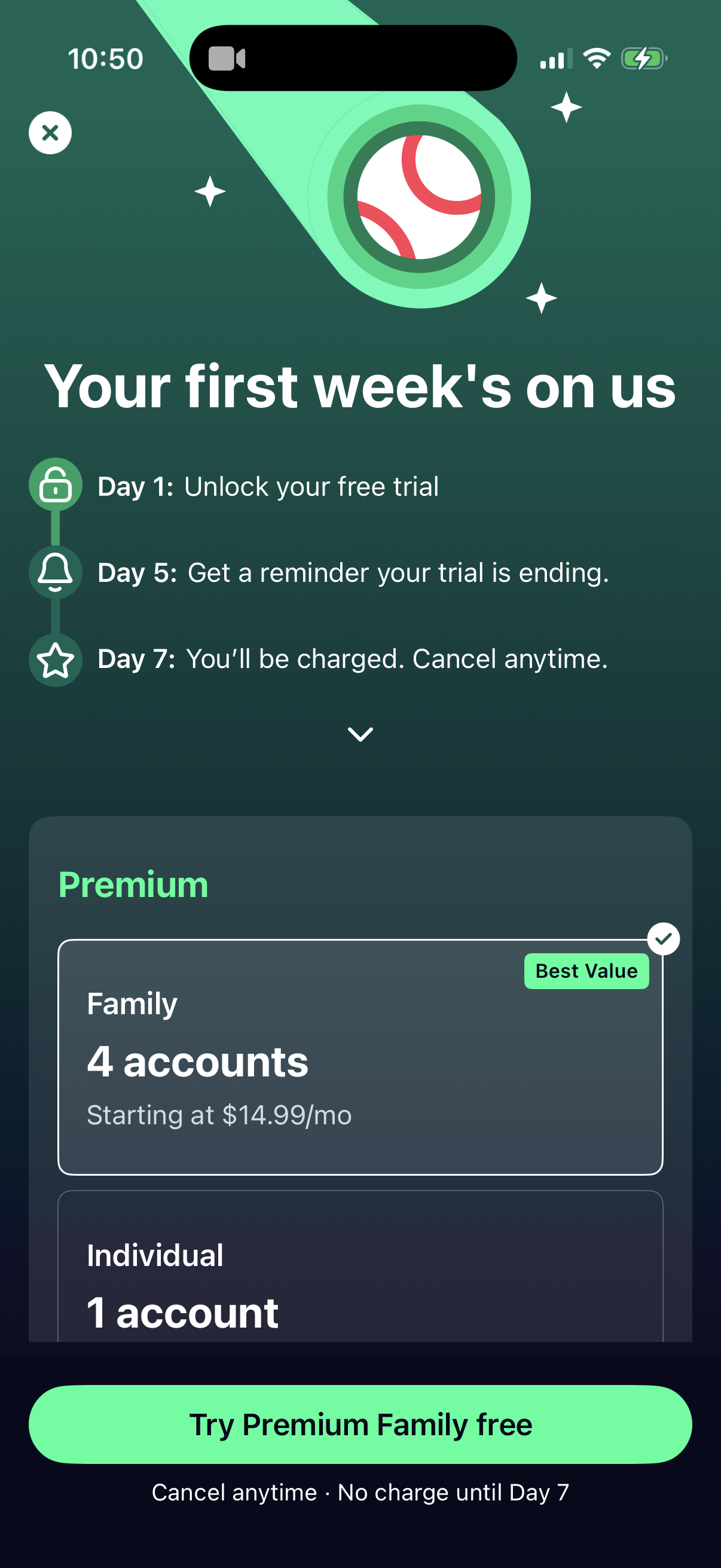
Gamechanger1206 × 2622opens the full image 
Lyft1179 × 2556opens the full image 
Wash Post1179 × 2556opens the full image 
Telegram1179 × 2556opens the full image
The numbers
| # | Stat | Computed from |
|---|---|---|
| [1] | Drops: live countdown (2:03:33:36) over strikethrough $169.99->$99.99 with 'GET 40% OFF' | named_countdown_example_drops |
| [2] | Gentler: 'Welcome Back!' + 'Offer ends in 0 hours' | named_countdown_example_gentler |
| [3] | 37 of 751 tagged companies (4.9%) run a genuine offer countdown timer | countdown_offer_prevalence_clean |
| [4] | Only 28 of 795 detected experiments touch countdown/urgency/limited-time framing | urgency_experiments_count |
Methodology
Universe: 751 tagged mobile-app companies plus 795 detected paywall-CTA experiments across 252 tracked apps, July 2026. Method: filtered countdown-tag prevalence plus qualitative reading of timer+discount pairings. Caveat: tag matching over-counts and pairings are named examples, not measured lift.
Sources
- [1]
Lazyweb Research analysis of detected paywall screens (252 tracked paywall companies), July 2026
Named example: Drops countdown + strikethrough price + 'GET 40% OFF' with seasonal variants.
- [2]
Lazyweb Research analysis of detected paywall screens (252 tracked paywall companies), July 2026
Named example: Gentler win-back + 'Offer ends in 0 hours'.
- [3]
Lazyweb Research analysis of 751 tagged mobile-app companies (44,873 tagged screenshots), July 2026
Genuine offer countdown prevalence after excluding non-urgency timers and one high-volume ecommerce app.
- [4]
Lazyweb Research analysis of 795 detected paywall-CTA experiments (252 tracked paywall companies), July 2026
Experiments touching countdown/urgency/limited-time framing; detected diffs, not measured lift.
Source: Lazyweb Research — proprietary analysis of real, in-market app screens. Cite as Lazyweb Research, 2026-07-07.